
One extra degree changes everything.

More than 1 million copies sold. This new edition takes you further. It’s built for people who want more from themselves, and for leaders who want to bring that out in others.
Read the sample below or download it.
Exclusive to this edition:
Rewritten introduction that goes deeper into what 212 actually means, and why the last degree is never the whole story
Simple 4-step process for developing your 212 mindset
14 reflections and 27 real-world examples for applying the extra degree—at work, in relationships, and in everyday life
For leaders: 4-point approach to helping others develop their 212 mindset, plus 8 principles for creating a high-trust team
Paperbacks & eBooks available at Amazon. (As an Amazon Associate, I earn from qualifying purchases.)
Read the sample below or download a sample.
New release: Lead Kindly.
a spark
Water is hot at 211 degrees.
Heat it to 212 and it boils, producing steam.
And with steam, you can create power.
One extra degree changes everything.
°°°°°
1 more degree and we have something useful and meaningful—something that can power machines, industries, and cities.
An inviting metaphor that, on its surface, implies ease. Just a little extra effort, and we can create something wonderful. True at times, but the real value in the 212 concept is deeper. It shines a light on the importance of developing one’s ability to be consistently attentive, mindful, and caring.
The initial simplicity of the message is helpful. It quickly captures the mind and heart as something “even I can do.” It’s optimistic and hopeful. Who can’t put in a little extra effort?
So, the idea connects, sticks, and shows up as action more than it might otherwise, keeping us rooted in the awareness that sometimes a little more matters.
And with awareness comes responsibility—and opportunity. The more we see and experience 212 examples, the more likely we are to cultivate and nurture a set of habits (discipline) and a way of thinking that leads to more consistent action, giving ourselves a better shot at the special and meaningful things we might want.
And that’s it, the deeper truth of the 212 concept.
It’s consistent attention and effort over time that gets us to special. That last degree gives us our steam, but it’s preceded by 211 other degrees.
There’ll be times when that last degree is easier to reach than it is scientifically.* But, the real message here is to be as consistent as we can in developing and strengthening our ability for good thinking and doing, to reach and keep reaching, and to love and keep loving.
Excited?
*Scientifically, the energy needed to get from one degree to the next increases as the temperature increases. So, scientifically, that last degree is never easy. But a smile or a simple kind statement that can dramatically change the mood of the room, is.
°You and the spark. In the end, they’re one in the same. You guard that because it’s precious. Now it’s time to get to work.
Martin Scorsese
American filmmaker | 1942—
212 attention

Wall mural in the Oregon Hill area of Richmond, VA.
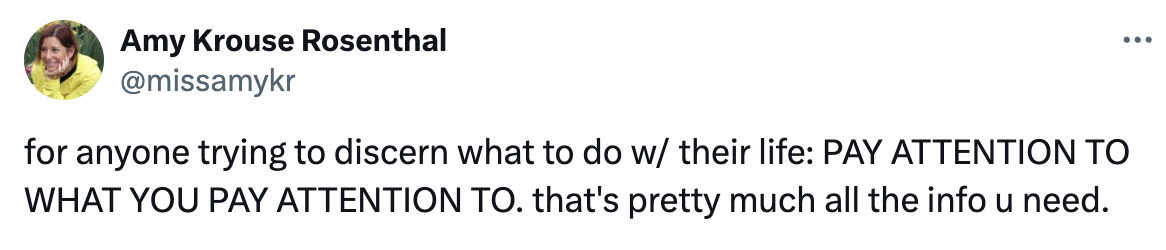
°Pay attention to what you pay attention to.
Amy Krouse Rosenthal
American writer | 1965 – 2017
°°°°°
Everything we do begins with attention.
Beautiful word—attention. It’s not only about regarding someone or something as interesting or important. It’s also the action of dealing with or taking special care of someone or something.
All kinds of joy in there. Noticing. Acknowledging. Listening. Seeing. Doing. Caring.
And we all have these moments where we can choose to give our deep, focused attention to what’s important, or not. To the person in front of us, or not. To the work, or not. To the opportunity, or not. To be present, or not.
Making the right choices about where we put our attention isn’t the biggest challenge most of us face in our daily lives. It’s staying with the right choices. It’s being awake, doing, learning, adjusting, adapting, and learning again. It’s putting in the work, the time.
Few quick and effortless paths lead to wonderful. Waste as little time as you can looking for them.
That doesn’t mean the path needs to be unpleasant, grinding, or painful. It might be at times. But it can also be surprising, educational, fun, and relaxing. Please don’t let me lose you to the idea that living a 212 life is a never-ending grind where nothing is ever good enough.
Living a 212 life is living deliberately while enjoying the occasional serendipity that deliberateness brings. It’s nurturing (practicing & strengthening) our ability to find joy in giving something/someone consistent attention and effort, and, when things get challenging, real or imagined, in the resilience.
212 is about taking advantage of now.
*Rosenthal was a prolific writer. I included her opening thought to this chapter a little out of context. It’s valuable either way, I think. The full context—
°Really, it's a matter of what your attention can land on and fully engage with moment to moment. And that is the secret to finding well-being in this life.
Sam Harris
American neuroscientist & writer | 1967—
seeing 212

I walked up to this once on the Charles River in Boston, MA. Look close. Two 212s.
After we’ve had a few decades of life, it should be easier than it sometimes is to embrace the truth. Deep attention and extra effort are fundamental to making good things happen. But to be sure—
Two-twelve is all over professional sports.
At the highest levels, the difference between winning and losing or missing and making a shot is often very small. Sports are filled with fractions of seconds and inches that lead to big rewards.
To win a match, World Cup soccer teams score what usually ends up being 1 or 2 more goals than their opponent over 90 minutes of play. Olympic athletes chase split seconds to take home a gold medal over nothing at all.
Buzzer beaters, extra points, penalty kicks, and shots. We see that extra degree so many times. And while it’s easy to see in the final moments of play, remember there’s always 212 effort and attention along the way that sets up those final opportunities.
°One absolutely cannot tell, by watching, the difference between a .300 hitter and a .275 hitter. The difference is one hit every two weeks... The difference between a good hitter and an average hitter is simply not visible.
Bill James
American baseball writer & statistician | 1949—
Dig even deeper and consider the work that allows athletes to compete professionally. It’s years of attention, effort, and experience that put them there, many of which are childhood years. Innate talent, too, of course. And it’s not only their work, but also the work of many others (coaches, teammates, parents, tutors).
This is the case for almost everyone who does wonderful work. Individual attention and effort. Team attention and effort.
Authors write thousands of sentences that we never see to get to the published words we read in books. Musicians plod through unused notes and lyrics to find the songs we finally enjoy. Thousands of hours with people and experiences develop the leaders we admire.
That’s the individual work.
Then there’s the teamwork. All those people who help the writers and musicians get the words and music out. All those teachers, trainers, and mentors who play a part in the development of our leaders.
Attention. Effort.
“But I’m just a regular person. I’m not on a stage, field, or in a leadership position.”
Everyone’s a regular person. We’re just called to (interested in, curious about) different things with our different talents and various levels of luck.
Sure. There are some extremely fortunate people in any given lifetime who seem charmed at every point. But so often, it seems like those extremely fortunate people tend to work the gift even harder. That's what 212ers do. They work the gift.
We all have an opportunity to live a 212 life in our own ways, wherever we are (time, location, circumstance). We just have to make the choice and practice that choice. That means giving our attention to now (this moment) and getting back to now when we realize our attention drifts or effort drops.
No matter the work, routine or exciting, we can always two-twelve it.
Of course, living a 212 life isn’t just about work. The benefits of deep attention and extra effort show up in our relationships, our solitude, and our fun, too.
°It’s true of everything. All real meaning accrues in duration. The work you’re proudest of benefited from sustained attention.
Ken Burns
American filmmaker | 1953—

Spotted outside my office window once in Richmond, VA.
how to develop your 212 mindset
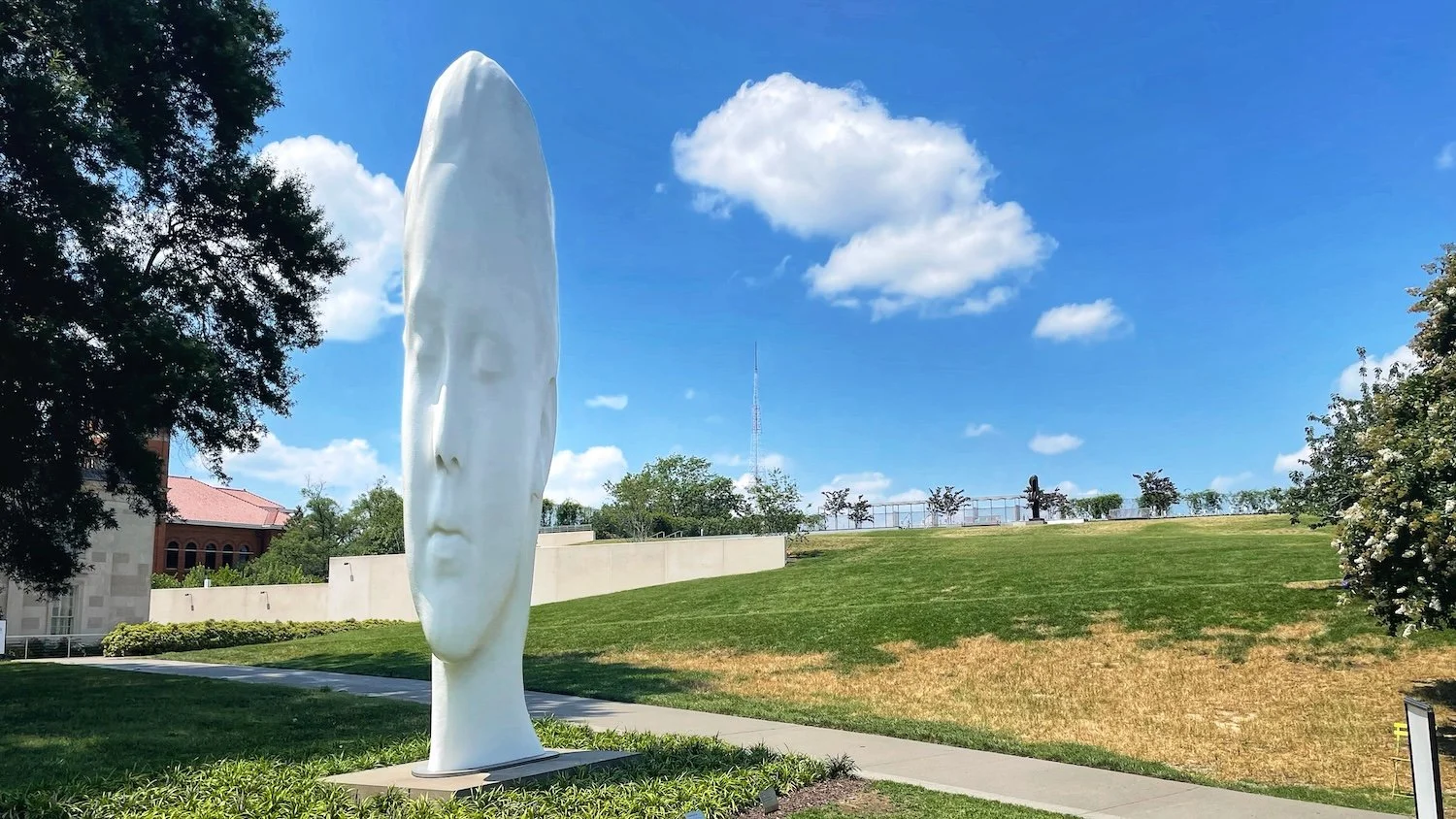
Chloe by Jaume Plensa at the Virginia Museum of Fine Arts in Richmond, VA.
A 212 mind is a reaching mind.
It comes to some with ease. They’re born with it. They can’t see things any other way. It’s an optimistic curiosity, an enthusiasm for thinking, learning, and continually improving things. A gift.
Others might discover it on their own through experience or an introduction to it, like this book is doing for someone now, hopefully you.
Either way, as with so many important things to living an enjoyable life, the reaching mind needs to be nurtured continually if one wants it to stay strong. It should be self-nurtured and guided by others, too.
If you’re one of the lucky ones born with a 212 mind that naturally self-nurtures, enjoy that good fortune. Just be careful not to look away for too long. Atrophy of something good is unpleasant.
Also, if you have that gift, like someone who receives a large inheritance or lands in a place of power from a few fortunate turns, the kind thing to do is to help those with less good fortune when you can.
“I want a 212 mind.”
Good. It’s more fun. There’ll be obstacles at times—other people, circumstances, you. But, if you really want to enjoy where the reaching mind can take you, you have to make a choice to—
Pay attention as much as you can.
Minimize your ego.
Nurture your joy for continually making things better for others and yourself.
Stay with it through the challenges.
Tough to do if you’ve let the wind guide your mind for a long time or actively developed the reverse. I’ve been there and I’m still there at times, even with more decades than you on this planet. But the choice is always there for you.
Practice and resilience are the roots of a 212 mind. They keep the momentum moving toward good, reaching.
Practice is action and paying attention to action; noticing and adjusting based on experience.
Resilience is the ability to get back to good when things don’t go well. Clean and fast resilience is the goal. No weight. Light. A special place where mistakes and misses don’t linger in the air and trip up progress.
None of this articulation is about a cute or clever acronym with some trite image of steps, a gear, or a wheel. It’s about helping you play a consistently better role in making good things happen for yourself and other people. Me too. Writing this helped me see things I’ve not noticed before. (See that‽ We’re a team.)
A reaching mind is a 212 mind—
Pay attention as much as you can.
Minimize your ego.
Nurture your joy for continually making things better for others and yourself.
Stay with it through the challenges.
We’re all at different places in our ability to do each of these things. If you’re weak with a point, don’t worry about it. Just start to practice. It probably won’t be a clean linear progression like you see in the movies. Just jump into the mess of it, knowing it can be a wonderful thing in time.
Enjoy the beauty and energy of not settling. Step away from any bad history.
The choice is always there.
°The soft minded person always wants to freeze the moment, and hold life in the gripping yoke of sameness.
Martin Luther King Jr.
American civil rights activist
Nobel Peace Prize winner 1929 – 1968
1. Pay attention as much as you can.
Paying attention is the deliberate act of directing your mental focus toward something specific. It’s sustained attention with intent to notice—to see and process.
It’s an investment of your mind to become aware. Best done undivided, when you can. More challenging in the last 25 years, given technology and all that it’s bred, but it can be done.
You’re doing it now.
You’re reading to explore and discover something that might improve how you approach things, something that might make your relationships and experiences better, maybe even fatten your bank account. You might also find something here that gives you more confidence about the way you do things now, a validator.
Your attention is here.
I’m no mental giant. I’m often a puppet to my thoughts and react like a bug. But, with practice and guidance from others—reading, watching, listening, noticing—I believe my life is better than it would be otherwise. A little better every so often, with a few slips along the way, works for me. It can work for you, too…
Exclusive to this new edition—
Rewritten introduction that goes deeper into what 212 actually means, and why the last degree is never the whole story
Simple 4-step process for developing your 212 mindset
14 reflections and 27 real-world examples for applying the extra degree—at work, in relationships, and in everyday life
For leaders: 4-point approach to helping others develop their 212 mindset, plus 8 principles for creating a high-trust team
Paperbacks & eBooks available at Amazon.
Pictures are black and white in the paperback.
(As an Amazon Associate, I earn from qualifying purchases.)
Please email with comments or questions about the book.
Download this sample. New release: Lead Kindly.
© 2026 212 Books | Richmond, Virginia USA | 804-335-1283